

The Benefits of Forward Bending Yoga Poses: Flexibility, Balance and Inner Calm
Led by Paddy Hamill @ Santosha Yoga Studio | Lisburn, Northern Ireland 10th October 2026.
Forward bending yoga poses are among the most rewarding and beneficial postures in yoga practice. Whether performed standing, seated or lying down, these asanas can help improve flexibility, release muscular tension, develop body awareness and encourage a quieter, more reflective state of mind.

At Santosha Yoga Studio in Lisburn, we believe that forward bends are about much more than simply touching your toes. When practised with patience, awareness and correct alignment, they offer an opportunity to explore the relationship between movement, breath and the mind.
From the familiar downward-facing dog to more challenging seated forward bends, these postures can be adapted to suit different levels of experience, making them an important part of a balanced yoga practice.
In this article, we explore the physical and mental benefits of forward bending asanas, examine five important postures and explain how the intelligent use of yoga props can make them more accessible and effective.
Understanding Forward Bending in Yoga
Forward bending involves flexion at the hip joints, often accompanied by varying degrees of spinal movement. Although many people associate forward bends with stretching the hamstrings, their effects extend to several areas of the body.
The muscles commonly involved include the hamstrings, gluteal muscles, spinal extensors and, depending on the posture, the calves and muscles around the hips.
An important principle when practising forward bends is to distinguish between movement at the hips and movement through the spine.
In many forward bending asanas, the initial movement should come from the hip joints, allowing the pelvis to rotate forwards while maintaining comfortable length through the spine. This helps distribute the movement more effectively and avoids forcing the lower back into excessive rounding.
However, yoga is not about creating rigid shapes. The natural curves of the spine, individual skeletal differences and each student's flexibility should always be considered.
The Physical and Mental Benefits of Forward Bends
1. Improving flexibility and mobility
Regular, progressive practice of forward bends can improve the flexibility of the hamstrings and surrounding muscles while developing greater mobility through the hips.
This may make everyday activities such as bending down, putting on shoes and moving from sitting to standing feel more comfortable.
2. Relieving muscular tension
Many people experience tightness through the backs of their legs and around their hips, particularly when spending long periods sitting.
Forward bends provide an opportunity to gently lengthen these tissues and explore areas of muscular restriction. Supported variations can also encourage the muscles of the back to relax.
However, not all lower back discomfort is caused by muscular tightness, and forward bends are not appropriate for every back condition.
3. Developing postural awareness
A carefully taught forward bend encourages students to become more aware of the relationship between their feet, legs, pelvis and spine.
Learning to move from the hip joints, rather than simply collapsing forwards, can improve movement control and body awareness.
4. Encouraging relaxation and reducing stress
Slow, supported forward bends are often experienced as calming and introspective.
When combined with relaxed, steady breathing, they can help reduce the sense of physical and mental tension associated with a busy lifestyle.
Although the effects vary between individuals, the deliberate slowing of movement and attention to breathing can support relaxation and emotional wellbeing.
5. Improving concentration and mindfulness
Forward bends encourage us to turn our attention inward.
Rather than striving to achieve the deepest possible posture, students can learn to observe physical sensations, recognise unnecessary effort and develop greater patience.
This mindful approach reflects one of the central principles of yoga: practising with awareness rather than ambition.
Five Essential Forward Bending Yoga Poses
Each of the following postures offers a slightly different approach to forward bending. Together, they provide an excellent foundation for exploring flexibility, alignment and mindful movement.
1. Supta Padangusthasana – Reclining Hand-to-Big-Toe Pose
Supta Padangusthasana is an excellent preparatory posture for forward bending practice. Because it is performed lying on the back, it allows students to work on hamstring flexibility without having to support the weight of the upper body.
This makes it particularly useful for students with restricted flexibility or those who find seated forward bends uncomfortable.
How to practise:
Lie on your back with both legs extended. Bend one knee towards your chest and place a yoga belt around the ball of the foot. Slowly extend the leg upwards, keeping the shoulders relaxed and the pelvis relatively level.
The raised leg does not need to become completely straight. The important consideration is to maintain a comfortable stretch without straining the hamstrings or lower back.
Benefits:
Improves hamstring flexibility and hip mobility.
Encourages awareness of pelvic alignment.
Provides a controlled stretch through the back of the leg.
Helps prepare the body for standing and seated forward bends.
Allows students to explore flexibility without placing significant weight through the spine.
Using props: A yoga belt is particularly beneficial for students who cannot comfortably reach their foot. The opposite knee may remain bent, with the foot resting on the floor, to make the posture more accessible.
Teaching tip: Encourage students to maintain a gentle, steady breath rather than pulling the leg towards the head. Progress comes from consistency, not force.
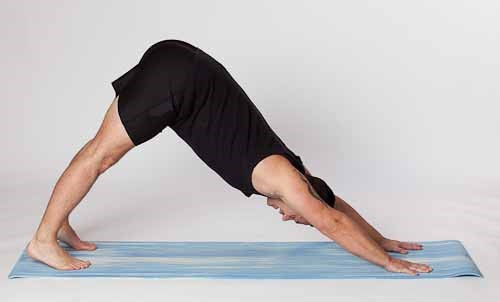
2. Adho Mukha Svanasana – Downward-Facing Dog
Adho Mukha Svanasana is one of the most recognisable postures in yoga. Although frequently used as a transitional asana, it is also a valuable forward bending posture that combines stretching, strengthening and body awareness.
Unlike passive forward bends, downward-facing dog requires active engagement of the arms, shoulders and legs.
How to practise:
Begin on your hands and knees, positioning the hands slightly ahead of the shoulders. Tuck the toes under and lift the hips upwards and backwards, creating an inverted V shape.
Press firmly through the hands, extend the arms and lengthen the spine towards the pelvis.
Allow the knees to remain slightly bent if necessary. The heels do not need to touch the floor.
Benefits:
Lengthens the calves and hamstrings.
Strengthens the shoulders, arms and upper body.
Develops awareness of spinal extension and hip flexion.
Encourages coordination between the upper and lower body.
Can provide an opportunity to reconnect with steady breathing.
Using props: Students with tight hamstrings can bend their knees to prioritise spinal length. Placing the hands on stable yoga blocks or using a wall-supported variation can help those with restricted mobility.
For students with wrist discomfort, modifications should be considered to reduce weight-bearing through the hands.
3. Prasarita Padottanasana – Wide-Legged Standing Forward Bend
Prasarita Padottanasana is a particularly useful standing forward bend because the wide stance provides a stable base from which to explore hip movement and spinal length.
The posture stretches the hamstrings and inner thighs while encouraging awareness of weight distribution through the feet.
How to practise:
Stand with the feet wide apart, keeping them approximately parallel. Place the hands on the hips, lengthen the spine and begin to hinge forwards from the hip joints.
As the torso moves forwards, place the hands on the floor or on yoga blocks.
Students with greater flexibility may gradually lower the crown of the head towards the floor, provided they can do so comfortably and without forcing the neck.
Benefits:
Stretches the hamstrings and inner thigh muscles.
Develops hip mobility.
Encourages balanced weight distribution through the feet.
Strengthens postural awareness.
Provides an opportunity to practise a controlled hip hinge.
Using props: Yoga blocks positioned beneath the hands are extremely helpful. They allow students with restricted flexibility to maintain spinal length without forcing the body towards the floor.
Teaching tip: Encourage students to distribute their weight evenly between the front and back of the feet rather than allowing all their weight to move into the heels.
4. Upavistha Konasana – Seated Wide-Angle Forward Bend
Upavistha Konasana is a seated forward bend that works particularly strongly through the hamstrings and adductor muscles of the inner thighs.
It also encourages students to explore the relationship between pelvic position and spinal movement.
How to practise:
Sit on the floor with the legs extended into a comfortable wide position. Keep the knees and toes pointing upwards as far as comfortably possible.
Place the hands on the floor in front of the body and gradually walk them forwards, allowing the pelvis to rotate over the heads of the thigh bones.
Avoid pulling the chest down or collapsing through the lower back.
Benefits:
Improves flexibility through the inner thighs and hamstrings.
Encourages greater awareness of pelvic positioning.
Develops mobility around the hip joints.
Provides a foundation for more advanced seated postures.
Encourages patience, concentration and mindful movement.
Using props: Sitting on one or two folded blankets can help students with tight hamstrings maintain a more comfortable upright position.
A bolster or yoga blocks may be placed in front of the body to support the torso or forearms during a gentler variation.
5. Paschimottanasana – Seated Forward Bend
Paschimottanasana is one of the classical seated forward bends and holds an important place in traditional Hatha Yoga.
The Sanskrit name is commonly interpreted as the intense stretch of the west, referring to the back of the body.
It is a posture that encourages both physical flexibility and mental stillness.
How to practise:
Begin in Dandasana (Staff Pose), sitting with both legs extended forwards.
Establish an upright position through the spine, allowing the pelvis to sit comfortably on the sitting bones.
Inhale to lengthen the spine and, on an exhalation, begin to fold forwards from the hips.
The hands may rest on the legs, hold a yoga belt around the feet or reach towards the feet, depending on the student's flexibility.
The objective is not to bring the head to the knees but to develop a controlled, comfortable forward bend.
Benefits:
Lengthens the muscles along the back of the legs.
Encourages mobility through the hips.
Develops awareness of spinal and pelvic alignment.
Can promote relaxation when practised slowly and with support.
Encourages introspection and a quieter mental state.
Using props: Sitting on folded blankets can make the posture more accessible. A yoga belt around the feet allows students to maintain a comfortable position without straining.
A bolster placed over the legs can support the upper body during a restorative variation.
Why Props Are So Important in Forward Bending Practice
At Santosha Yoga Studio, we encourage the intelligent use of yoga props to make postures more accessible, supportive and effective.
Yoga blocks, belts, blankets and bolsters are not simply aids for beginners. They can benefit practitioners of every level by improving alignment, reducing unnecessary strain and allowing greater awareness within each posture.
For example, a student with restricted hamstring flexibility may struggle to maintain an upright pelvis in a seated forward bend. Sitting on a folded blanket can change the relationship between the pelvis and the legs, allowing the student to work more comfortably.
Similarly, blocks placed beneath the hands in standing forward bends can reduce the temptation to force the body towards the floor.
The aim is always to create an appropriate balance between effort and ease.
The Importance of Sequencing Forward Bends
A well-structured yoga practice should prepare the body progressively rather than introducing demanding forward bends before the muscles and joints are ready.
At Santosha Yoga Studio, we emphasise the importance of intelligent sequencing, good technique and correct alignment, particularly in our intermediate classes and yoga teacher training programmes.
A useful approach is to begin with gentle mobility and reclining stretches, progress through standing postures and finish with seated forward bends.
Forward Bends and the Philosophy of Yoga
Beyond their physical benefits, forward bending postures provide a valuable opportunity to explore some of the deeper principles of yoga.
In the Yoga Sutras of Patanjali, the concept of Sthira Sukham Asanam reminds us that a yoga posture should embody both steadiness and ease.
This principle is particularly relevant to forward bends.
When students attempt to force themselves deeper into a posture, they may create unnecessary muscular tension, restrict their breathing and lose the sense of awareness that makes yoga practice meaningful.
By contrast, approaching forward bends with patience allows the practitioner to develop a more sensitive relationship with the body.
There is also a symbolic quality to forward bending. The movement of folding inwards can represent humility, acceptance and the willingness to release unnecessary effort.
Rather than constantly striving to achieve more, we learn to appreciate the experience of the present moment.
This is one of the reasons forward bends can be particularly valuable during periods of stress or mental fatigue.
Practising Forward Bends Safely
Although forward bends can offer considerable benefits, they should always be approached with an understanding of individual limitations.
Students with acute back pain, certain disc conditions, osteoporosis, hamstring injuries or other relevant medical concerns may require modifications or alternative postures.
Those who experience dizziness or have difficulty tolerating positions with the head lowered should also exercise caution.
A qualified yoga teacher can help students identify appropriate variations, ensuring that flexibility is developed gradually without unnecessary strain.
Research supports stretching as a way of improving range of motion, although individual responses vary. Yoga is generally considered safe when practised appropriately, but injuries can occur, particularly when movements are forced.
The guiding principle should always be simple: work with your body, rather than against it.
Experience the Benefits of Forward Bending Yoga at Santosha Yoga Studio
At Santosha Yoga Studio in Lisburn, Northern Ireland, we offer yoga classes and professional yoga teacher training designed to help students develop their practice in a supportive and welcoming environment.
Whether you are relatively new to yoga or an experienced practitioner looking to deepen your understanding of asana, forward bends offer an opportunity to develop flexibility, improve body awareness and explore the calming qualities of mindful movement.
Our teaching places particular emphasis on safe alignment, intelligent sequencing and the appropriate use of props, allowing students to explore yoga at a level that suits their individual abilities.
Through our classes, workshops and accredited yoga teacher training programmes, we encourage students to look beyond the external shape of a posture and develop a deeper understanding of how yoga works within the body and mind.
Yoga is not about how far you can bend. It is about the awareness, patience and understanding you develop along the way.
To learn more about our yoga classes, workshops and teacher training programmes in Lisburn, visit www.santoshayogastudio.co.uk.
Santosha Yoga Studio – Yoga for All.


Comments